
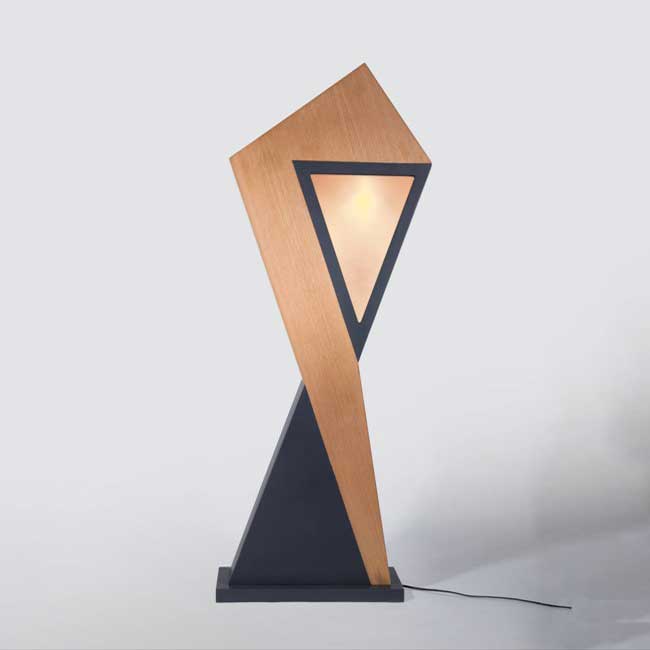




In this work, the form initiates a gentle rotation that evokes the whirling Sama found in Iranian architecture and mysticism, where movement generates meaning and stillness contains motion.
The work stands upright like the body of the dancer engaged in Sama. Its lines are angular yet soft, firm yet fluid. In its silence, the form evokes movement. Despite their apparent solidity, the angular lines remain flexible, like a skirt turning in the wind, bringing a sense of dynamism into a static space.
Light radiates from within, not as a cry but as a whisper—like a hidden spirit passing through the body and communicating with the viewer.
Material and light embrace one another, dissolving the boundaries between fullness and emptiness, presence and absence. One is solid and dark; the other is empty yet luminous. Together, they form complementary elements.
This interplay manifests a concept found in traditional Iranian spaces such as shabestans and orsi windows: the spiritual presence of light within matter.
From a phenomenological perspective, this object is not merely a physical form but a lived experience. The viewer does not simply stand before it; they participate in its rotation, as light and material intertwine to create an object that is not only seen, but felt.